

Charlotte Pipe
ENVIRONMENTAL DISPLAY + BRANDED SPACE
Charlotte Pipe and Foundry asked us to craft a museum-like experience for their new Product Knowledge Training center. They wanted environmental displays that would tell their brand’s history throughout the interior of the building. We developed two curated spaces to visualize their brand story through a historic gallery wall, display areas, and artifact cases, weaving narrative and highlighting key traits of Charlotte Pipe.
My Role
Designer
Creative Team
Creative Director: James Ward
Art Director: Brandon Scharr
Producer and Designer: Happy Carter
Copywriter: Rachel Baker
Agency: Wray Ward
Deliverables
Environmental Visual System
Concepting + Ideation
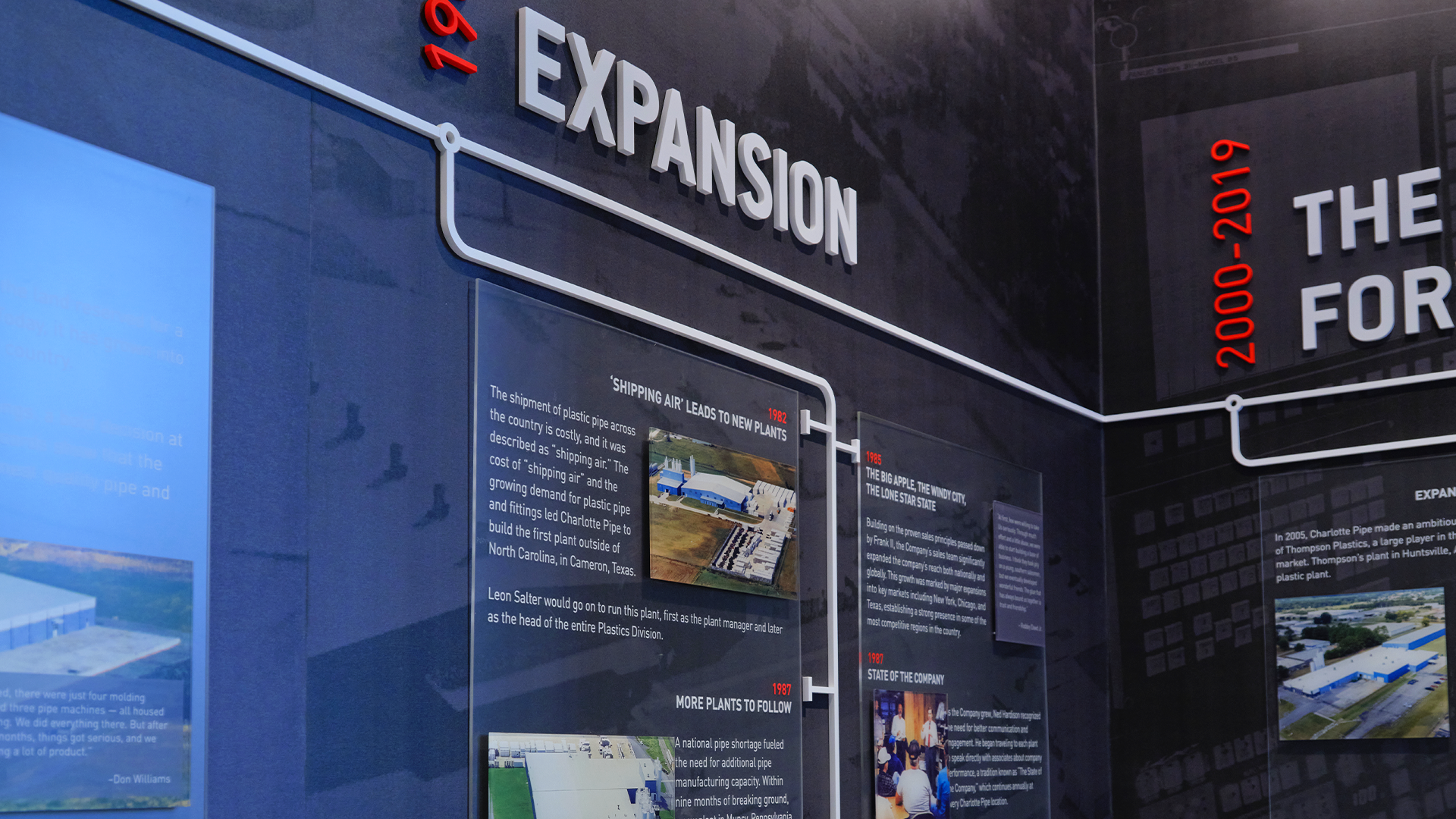
We pitched several ideas, including a timeline display wall that features drawers and pop-out shelves to allow for interactive storytelling. We planned to integrate a pipeline of their cast iron product throughout the display to create an immersive experience that would guide the viewer through the space.
The brand’s history would be further brought to life by incorporating items such as photos, quotes, old ads, newspaper clippings, and shadow boxes to house dimensional artifacts.

Modular Timeline Wall
Charlotte Pipe wanted a modular approach that would allow them to add or modify content in the future. We solved this by creating a timeline with individual panels to present the brand’s 120-year history, allowing photos, dates, and titles to be updated over time. The white lines that spread throughout the timeline give a subtle nod to one of Charlotte Pipe's products: PVC pipe.


Gallery Display Mockup
The purpose of this display is to present Charlotte Pipe’s people and culture in a way that showcases them as works of art but also immediately establishes one of their key brand propositions: Their products are made in America by people you can count on.

Gallery Display
CHALLENGES
Since a majority of the photography was either low resolution or sourced from historic artifacts, we needed to enhance the display’s appearance through material and fabrication.
Additionally, the designated display area was in a narrow hallway. As a result, we needed to design something that could fit flush against the wall and be viewed easily from a short distance.
SOLUTIONS
We used a dimensional approach that gives the photos striking weight within the space and allows photos to be changed out over time.
Likewise, we selected aluminum cast 3D letters for headlines to provide a refined museum-quality look.


